
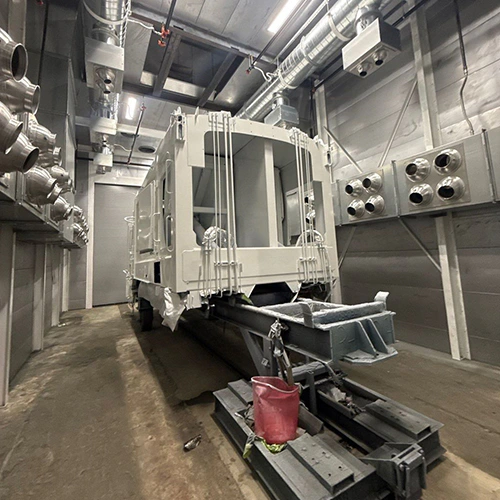
A digital temperature display showing an exact 400°F does not prove that every part on your rack reached cure schedule. The display generally reflects the control sensor’s measurement rather than the temperature of every part in the oven.
For a production or quality manager, scoping an oven calibration requires separating three distinct variables: the accuracy of the instrumentation, the spatial uniformity of the air across the work zone, and the thermal response of the parts moving through that air. Treating these three checks as separate engineering questions prevents passing an instrument check while producing under-cured coatings.
THREE DISTINCT QUESTIONS
- Controller & Sensor Loop: Is the displayed value true to reference?
- Work-Zone Air Uniformity: Is heat distributed evenly in the volume?
- Dynamic Part Profile: Does the substrate meet the cure window?
Define What the Verification Must Prove
Oven verification establishes whether your curing environment complies with equipment specifications, internal quality systems, and powder manufacturer technical data sheets. A common pitfall is conflating controller accuracy and temperature uniformity, assuming that a verified readout at the digital display guarantees an even thermal environment throughout the enclosure.
To build a reliable scope of work, define what each test validates:
- Loop accuracy: Compares the control instrument (thermocouple, lead wire, and digital temperature controller) against a certified standard. It answers whether the displayed temperature reflects the physical temperature at that specific probe tip.
- Work-zone uniformity: Measures spatial temperature variations across the empty or statically loaded working volume. It answers how evenly heat distributes from top to bottom, front to back, and wall to center.
- Substrate heating: Tracks the dynamic temperature rise of actual production parts under operating line speeds or batch bake cycles. It answers whether the coated metal meets the powder supplier’s minimum time-at-temperature window.
The applicable OEM documentation, customer requirements, and quality system determine which checks and records your operation needs. Knowing which variable failed tells you whether to look at instrumentation drift, airflow balance, or part hanging density.
Prepare the Equipment Baseline and Documentation
Before bringing in a qualified service provider, assemble the operating history and technical baseline. Technicians need clean access to equipment records, clear boundaries for the working volume, and a clear definition of representative operating loads.
Ask your service provider to verify:
- Traceable reference standards: Ensure reference instruments, multi-channel data loggers, and test thermocouples carry active calibration certificates traceable to national standards (such as NIST).
- Sensor condition and type: Identify the thermocouple types in use (typically Type J or Type K) and confirm lead wires, jack panels, and terminal connections are free of corrosion, mechanical wear, and heat embrittlement.
- Operating ranges: Define your standard operating setpoints. Tests should encompass the operating range established by your coating requirements and approved process.
- Load representative conditions: Document whether verification will take place empty, with a static baseline load, or during live production.
Before scheduling field service, review the manufacturer's model-specific oven service guidance to identify factory test ports, approved sensor types, and designated reference points. Having these details organized beforehand prevents technician downtime and keeps the service focused on reproducible data collection.
Have the Control Loop Measured Against a Reference
Checking controller accuracy requires comparing the installed temperature sensor and instrument readout against a calibrated reference standard. This check validates the measurement loop without altering equipment geometry.
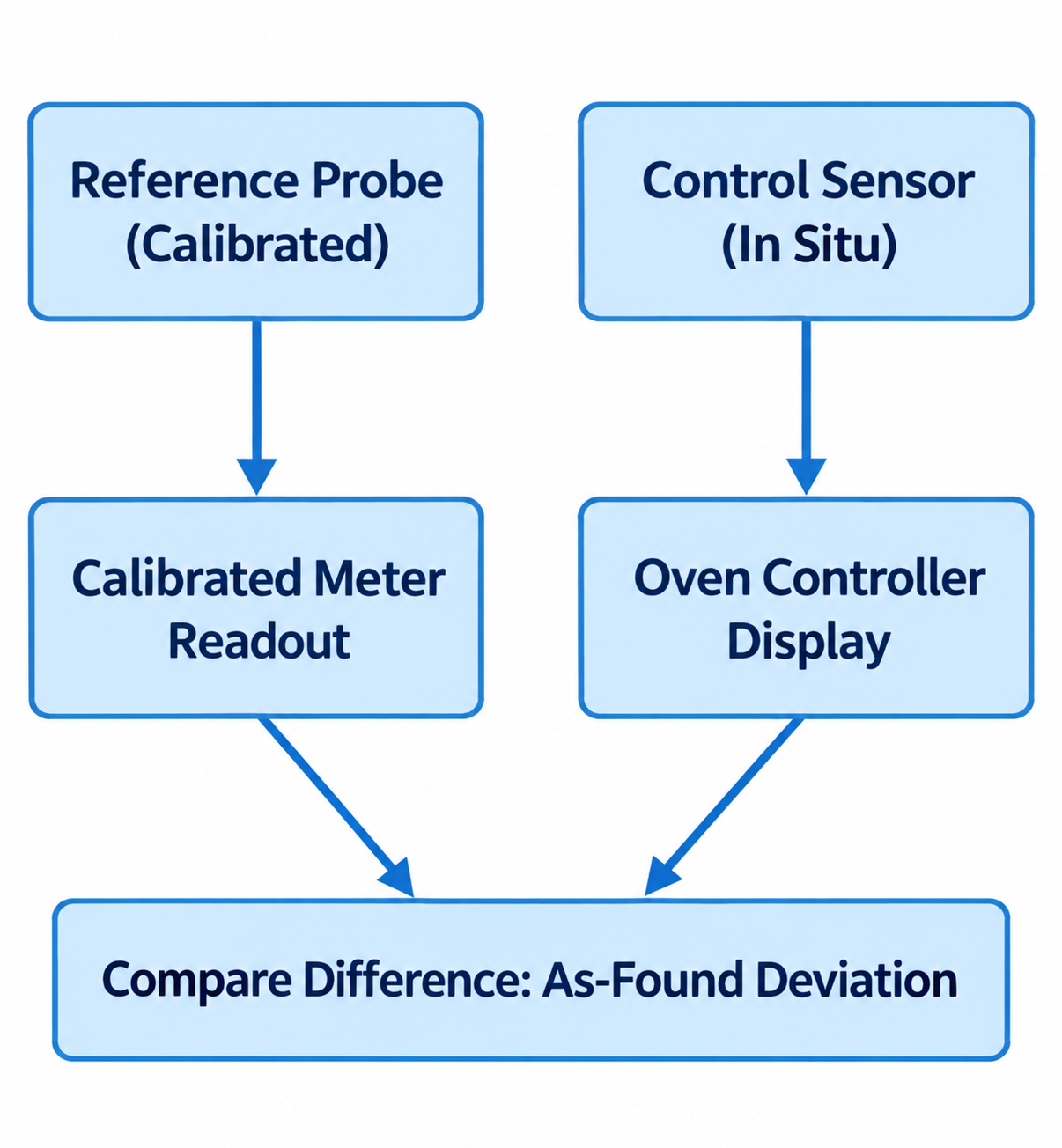
Diagram description
- Reference Probe
- (Calibrated)
- Calibrated Meter Readout
- Control Sensor
- (In Situ)
- Oven Controller Display
- Compare Difference: As-Found Deviation
- Reference Probe → Calibrated Meter Readout
- Control Sensor → Oven Controller Display
- Calibrated Meter Readout → Compare Difference: As-Found Deviation
- Oven Controller Display → Compare Difference: As-Found Deviation
- Reference Probe → (Calibrated): qualifier
- Control Sensor → (In Situ): qualifier
- Reference Probe (Calibrated) → Calibrated Meter Readout; Control Sensor (In Situ) → Oven Controller Display.
- Both readout/display feed Compare Difference: As-Found Deviation.
- No direct arrow between probes.
A qualified technician selects the reference method, measurement locations, and operating conditions prescribed for the equipment, then documents differences between the reference measurement and the installed control loop.
Under model-specific procedures, the technician inspects terminal blocks, cold-junction compensation, and lead wire integrity. They assess whether the deviation falls within factory limits.
Do not attempt informal offset adjustments or physical sensor relocations during this check. Moving the control sensor alters how the burner or heating elements modulate, which changes the thermal dynamics of the entire cabin.
Survey the Work Zone and Profile Representative Parts
Verifying the control loop confirms your digital display is truthful, but it tells you nothing about the corners of the oven box or the bottom rack of parts. Air delivery balance, exhaust rates, and wall losses create natural temperature gradients.
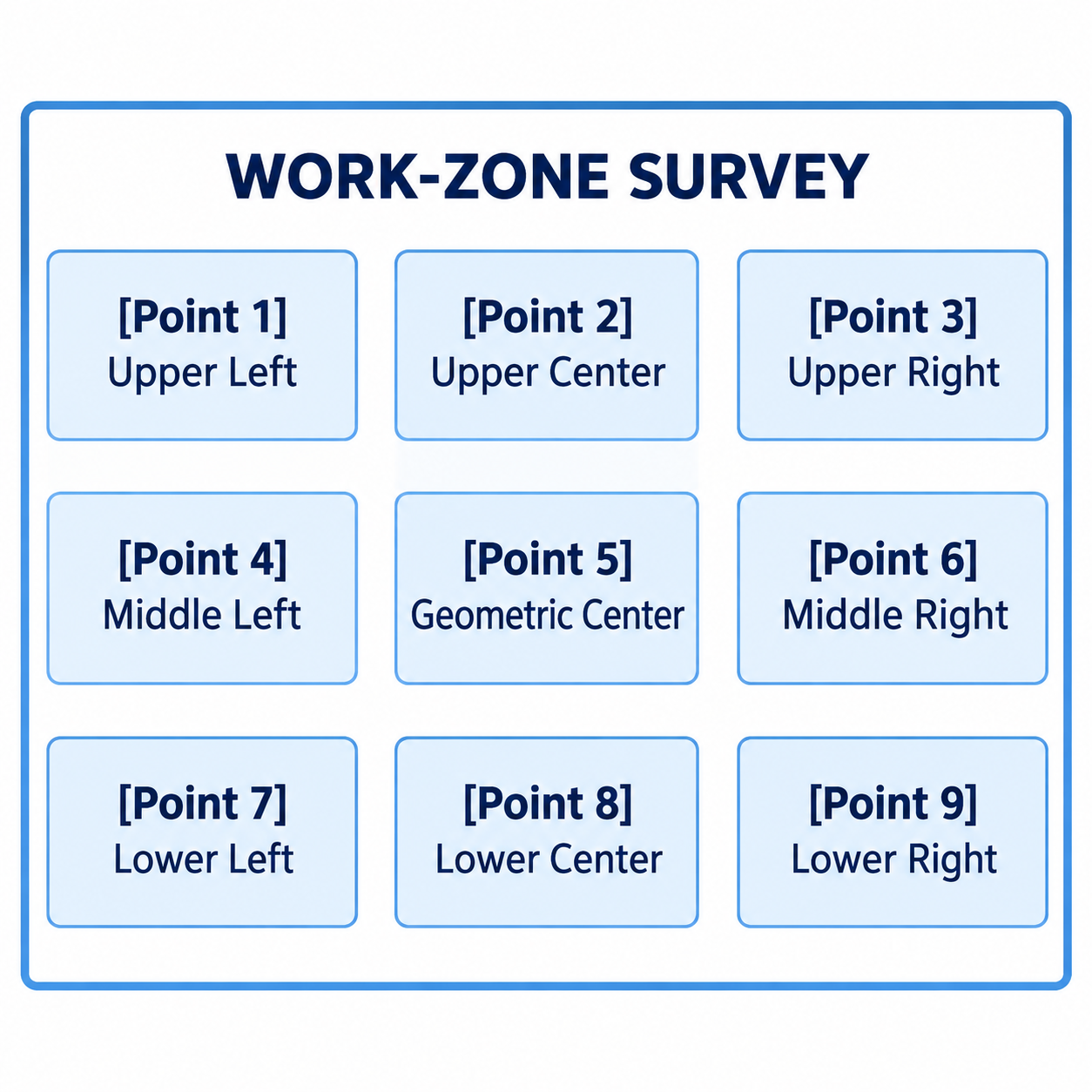
Diagram description
- WORK-ZONE SURVEY
- Point 1
- Upper Left
- Point 2
- Upper Center
- Point 3
- Upper Right
- Point 4
- Middle Left
- Point 5
- Geometric Center
- Point 6
- Middle Right
- Point 7
- Lower Left
- Point 8
- Lower Center
- Point 9
- Lower Right
- Outer WORK-ZONE SURVEY rectangle contains 3x3 positional grid.
- First row Point 1 / Upper Left, Point 2 / Upper Center, Point 3 / Upper Right.
- Middle row Point 4 / Middle Left, Point 5 / Geometric Center, Point 6 / Middle Right.
- Lower row Point 7 / Lower Left, Point 8 / Lower Center, Point 9 / Lower Right.
- No arrows.
Spatial Uniformity Surveys
A uniformity survey uses a multi-point array of test thermocouples distributed throughout the usable work envelope. The array maps the air temperature across high, middle, and low elevations, as well as perimeter and center locations.
The resulting data identifies cold spots near product doors, stratification where hot air pools near the ceiling, or hot blasts near burner supply ducts. When survey results point to severe temperature bands or stagnant corners, you transition from verification into powder coating oven troubleshooting to isolate air-balance issues, leaking door seals, or failing circulation blowers.
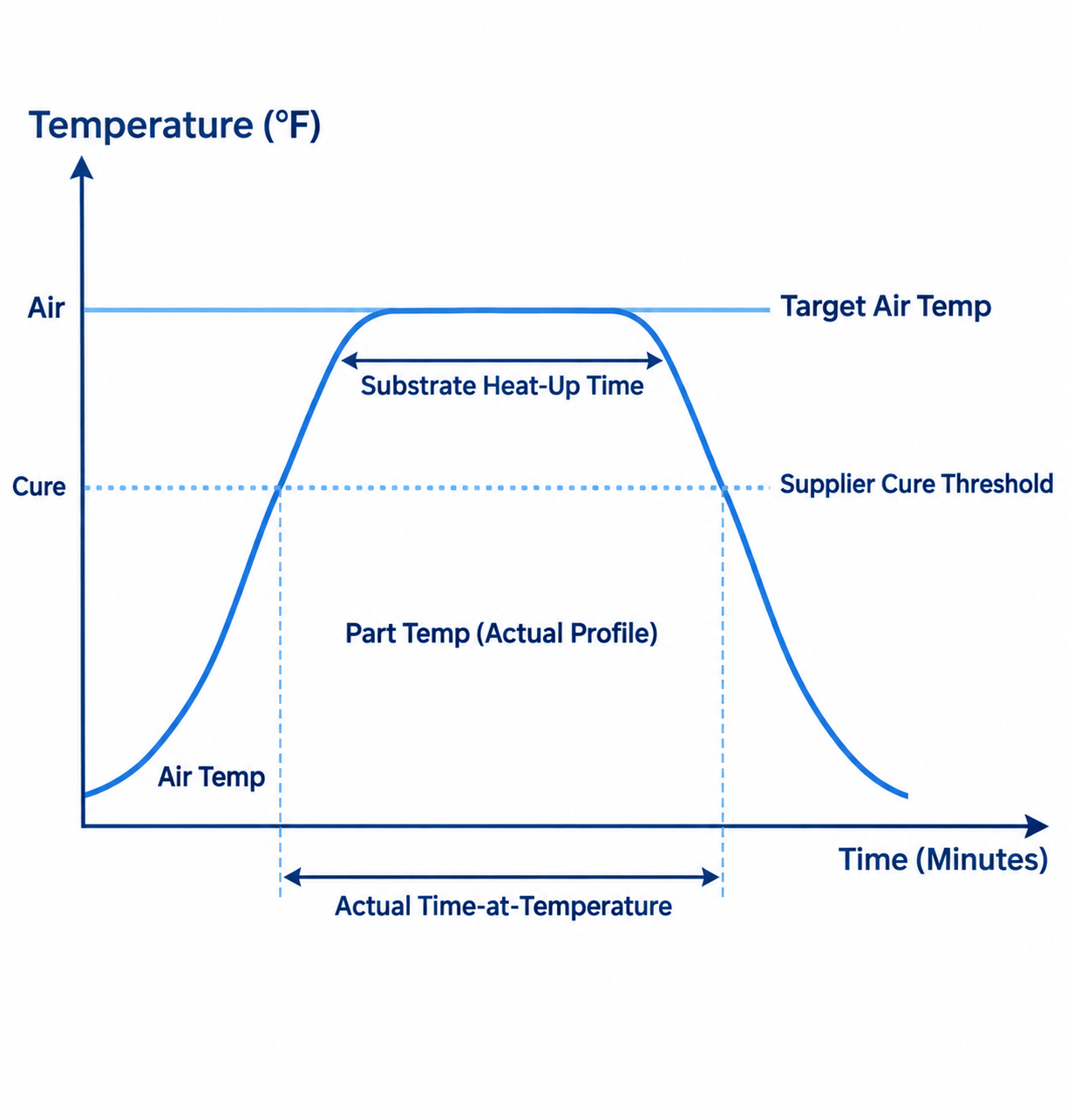
Diagram description
- Temperature (°F)
- Air
- Cure
- Target Air Temp
- Supplier Cure Threshold
- Substrate Heat-Up Time
- Air Temp
- Part Temp (Actual Profile)
- Time (Minutes)
- Actual Time-at-Temperature
- Chart y axis Temperature (°F), x axis Time (Minutes).
- Air tick level aligns solid horizontal Target Air Temp.
- Cure tick level aligns dotted Supplier Cure Threshold.
- Part Temp (Actual Profile) rises from low to upper plateau at Air level, then falls late.
- Air Temp label low left.
- Temperature (°F)
- Time (Minutes)
Dynamic Part Temperature Profiling
A work-zone survey shows what the air is doing, but a part profile reveals the actual part-temperature history, logging how dense brackets, hollow tubes, or sheet metal absorb heat over time.
A multi-channel thermal data logger protected by an insulated thermal barrier travels directly through the cure cycle with production parts. Thermocouples are attached directly to the metal substrate across different cross-sections:
- Heavy castings or thick plates that lag in reaching cure temperature.
- Thin sheet metal sections prone to heating rapidly.
- Leading and trailing edges of the rack.
A thermal profile plots metal temperature against elapsed time. Thermoset powder cure schedules specify the required part temperature and exposure; the supplier’s product-specific instructions determine the acceptable window. Profiling confirms whether your cycle accommodates the slowest-heating component without over-baking thin sections.
A data logger records this thermal curve clearly, but it does not evaluate finish quality on its own. The powder supplier and applicable quality requirements determine which adhesion, cure, or mechanical performance tests are appropriate alongside the thermal profile.
Read the Report and Establish Retest Triggers
The documentation provided at the end of a verification exercise serves as baseline evidence for quality audits and maintenance planning. A complete report should supply more than a single sign-off sheet.
VERIFICATION REPORT AUDIT
- ☑ As-Found Data (readings before any adjustments)
- ☑ Corrective Actions (mechanical, electrical, or combustion)
- ☑ As-Left Data (final verified state across all points)
- ☑ Measurement Methods and Calibration Traceability Standards
- ☑ Load Profile (rack layout, part part-numbers, conveyor speed)
Keep these records in your permanent equipment log:
- As-found and as-left data: Documents the precise variance of the instrument loop before and after any authorized technical adjustments.
- Measurement uncertainty and method: Outlines the reference tools used, their calibration dates, and the testing standard followed.
- Loading and operational conditions: Notes the conveyor line speed (or batch dwell duration), burner firing rate, ambient shop conditions, and part hanging configuration present during the test.
- Corrective work performed: Records whether technicians balanced dampers, repaired insulation, adjusted burner tune, or replaced degraded thermocouple leads.
Setting Re-Verification Intervals
Avoid defaulting to an arbitrary annual calendar date for your next verification. Establish intervals based on production criticality, operating hours, and structural triggers.
Schedule a new verification whenever:
- Burner components, combustion blowers, or heating elements undergo overhaul or replacement.
- Circulation fan belts are serviced, motors are replaced, or supply duct dampers are adjusted.
- Production shifts to a significantly heavier substrate or a denser rack configuration that restricts airflow.
- Periodic adhesion or solvent-rub testing reveals inconsistent cure across racks.
When verification reveals structural airflow limits or thermal bypassing that duct balancing cannot resolve, engineering teams evaluate replacement powder coating ovens designed with high-volume recirculation suited to varied part geometry.
If you are planning an audit of your cure operations or evaluating an upgrade to your line, contact an equipment specialist to discuss your finishing equipment.