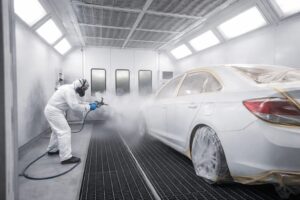
Ventilation in a paint booth is not optional and it is not just a comfort feature. It is a safety control designed to keep overspray, dust, and flammable vapors from building up. In most places, the rules expect mechanical ventilation that runs while spraying is happening and continues running after spraying long enough to clear lingering vapors from coated parts and from the booth interior. They also expect ventilation strong enough to maintain a minimum airflow across the booth opening or through the working zone, because airflow is what captures and carries contaminants away from people and away from ignition sources. Beyond “how much air,” the law usually cares about “how that air behaves,” meaning the airflow should be even and predictable. If airflow is patchy, turbulent, or short cycling, overspray can escape the booth and vapors can collect in dead zones.
Another widely enforced requirement is dilution control, especially when spraying solvent based coatings or any material that can produce flammable vapor. The intent is to keep vapor concentrations far below explosive limits. This is why booth sizing, fan selection, and the amount of air exhausted per minute must match the amount of solvent being released. If you change coatings, increase production speed, or spray larger parts, you can accidentally push a previously compliant booth into a risky range. A compliant system is one that can handle your highest realistic spraying load, not only your average day.
Exhaust system design rules that usually trigger inspection issues
Many legal frameworks treat spray booth exhaust as a dedicated hazardous exhaust stream. That means the booth should have its own exhaust duct system and it should discharge to a safe location outdoors. A typical expectation is that booth exhaust is not tied into general building exhaust or into systems that move air from unrelated processes. The goal is to prevent flammable vapors or paint residue from traveling into other duct runs, mixing with combustion appliances, or spreading contamination around the facility. It is also common for rules to restrict or prohibit recirculating booth exhaust back into the building. Even when a business wants to save energy, recirculation is often disallowed because it can reintroduce solvent vapors and overspray into occupied spaces.
Inspectors also look closely at how the fan and ductwork reduce ignition risk. Ducting is typically expected to be metal, properly supported, and routed in a way that allows cleaning access. The fan and motor arrangement matters too, because sparks, friction heat, and static can become ignition sources in a stream that may contain flammable vapor. Another common compliance point is the exhaust discharge location. Exhaust should not be positioned where it can be pulled back into the building through doors, windows, or HVAC intakes. It also should not discharge toward combustible surfaces or areas where people frequently work. In simple terms, the air you remove has to leave the property in a way that does not create a new hazard.
How to show compliance and reduce legal risk over time
In many inspections, the deciding factor is not only how the system was designed, but whether the business can prove the booth still performs as intended. A paint booth can start out compliant and drift out of compliance as filters load up, fans wear, belts slip, dampers get moved, or ductwork accumulates residue. For that reason, ventilation laws and enforcement practices often expect some form of ongoing verification. The most practical approach is to measure airflow performance on a set schedule, document the results, and have clear triggers for maintenance. This can be as straightforward as periodic face velocity checks, pressure readings across filters, and a written filter change routine that keeps airflow from falling below required levels. It also helps to train operators on the basics: ventilation should be on during spraying, it should remain on after spraying long enough to clear vapors, and the booth should never be used as storage in a way that blocks airflow paths.
From a legal standpoint, your best protection is a simple, repeatable system that connects three things: the booth’s intended airflow target, the actual measured performance, and the maintenance actions taken when performance drops. When those three are in place, you are not relying on guesswork or “it feels like it’s pulling.” You are showing that the ventilation system is actively managed to control exposure and fire risk. That is what most regulators and insurers want to see, and it is also what keeps real world problems, like lingering odor, overspray in the shop, flash fires, or employee complaints, from turning into expensive downtime.
Final thoughts
Legal ventilation requirements for paint booths are built around a simple idea: keep hazardous mist and vapors moving in a controlled path from the spray zone to a safe exhaust point, every time you spray. The details vary by location, but the expectations stay consistent. Use mechanical ventilation, maintain enough airflow to capture overspray and dilute vapors, use a dedicated exhaust design that minimizes ignition risk, discharge air safely outdoors, and prove the system keeps working through regular checks and maintenance. When ventilation is designed and managed this way, it supports compliance, protects workers, and helps the booth deliver cleaner finishes with fewer headaches.
At Paint Booth, we specialize in providing top-tier paint booths and finishing equipment tailored to your business requirements. Whether you need a standard-size paint booth or a custom solution designed for your unique projects, our expert team is here to assist you every step of the way. From design to installation, we ensure that your equipment meets the highest industry standards, enhancing both your productivity and the quality of your finishes. Contact us today to find the perfect paint booth solution for your business!